
Hey folks, to channel my inner millennial, I have decided to create this blog to document my experiences and thoughts on my preparation for the Ironman World Championship being held in Kona, Hawaii next year (October 10, 2020). The objectives of this blog are threefold:
- First and foremost, my hope is that this medium would allow me to more comprehensively share my journey with family, friends, and colleagues; something that I have found difficult to adequately capture in single conversations.
- Secondly, my hope is that this blog can provide a source of information for those of you who may be interested in trying out the sport. I will caveat this by mentioning that I am by no means an expert in this field and represent a sample size of one. At the very least, these posts should provide insight on what worked for me and/or highlight mistakes that I have made that others can avoid. To the extent that I make any incorrect statements, please feel free to let me know in the comments section.
- Should I fail in the above two objectives, at a bare minimum, this blog would hopefully serve to capture a snapshot of myself today, providing all of us an opportunity to look back many years hence and marvel and laugh at how one’s values can change over time.
Personal Introduction:
While this blog is primarily intended for family and friends, for those of you who have been referred to or happened upon it, a brief introduction is in order:
My name is Preston Han and I stumbled upon the sport of triathlon back in 2016, having watched two college friends participate in the New York Triathlon that year. The immense focus that they dedicated to their training and multidisciplinary aspect of the sport immediately piqued my curiosity, and having purchased a bike the previous year as an added incentive to get back in shape and having previously run on a purely casual basis, I realized that I “only” needed to pick up swimming in order to get in on the action as well.
While I had played varsity-level squash in high school and college (with little to no distinction), my background in endurance sports was limited, consisting of swim lessons in elementary school and a brief stint at cross country running in middle school. As such, my first steps into the sport were humble to say the least; being only able to swim a single pool length (25m) at a time, ride for an hour (~20mi), and run a mile or two at a pedestrian 9 min/mi pace. A detailed overview of the methods and strategy behind the progression since then will be covered in a subsequent post.
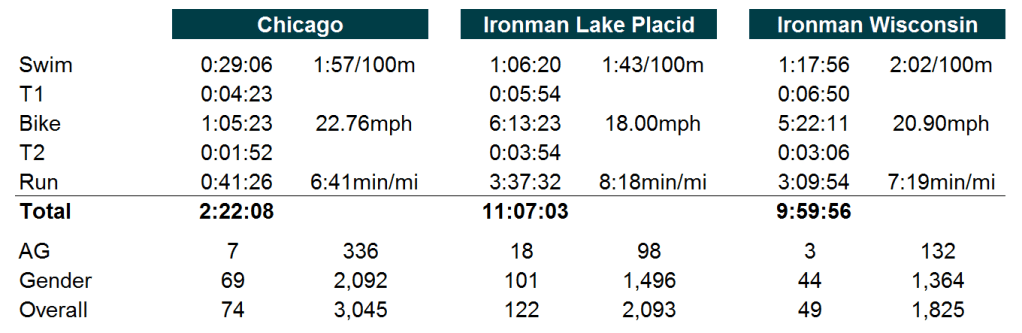
My first race experience was the 2017 Transamerica Chicago Triathlon, a crowd-favorite Olympic-distance event which spans across the tourist highlights of the Windy City and served as both a fun and gentle introduction into the nuances of the sport. Having thoroughly caught the bug, I decided to make the big step up from Olympic to long-course distance and competed at Ironman Lake Placid in 2018, followed by Ironman Wisconsin in 2019, at which I had the immense privilege of qualifying for the 2020 Kona World Championship. The results of these three races are summarized in the table below.
Triathlon for Dummies!
For those of you less familiar with the sport, a triathlon is a multisport race, most commonly consisting of swim, bike, and run segments in that order. A transition area is set up where athletes change gear for different segments of the race. The transition from swim to bike is referred to as T1 and that between the bike and run is referred to as T2. The athlete’s overall time for the race includes time spent in T1 and T2. The need to compete across three sports adds an additional layer of complexity for athletes not only in terms of training time management, but also due to the fact that the physical requirements for each activity oftentimes conflict with each other (e.g. the upper-body musculature required for swimming acts as non-functioning dead-weight for cycling and the lower-body rigidity / “snap” required for running generates greater drag in swimming).
The following ad produced by Cervelo, although shameless marketing, provides a great overview of the activities and ethos that a triathlete undertakes:
Triathlons can occur over a wide variety of distances, a summary for the most common of which can be found below.
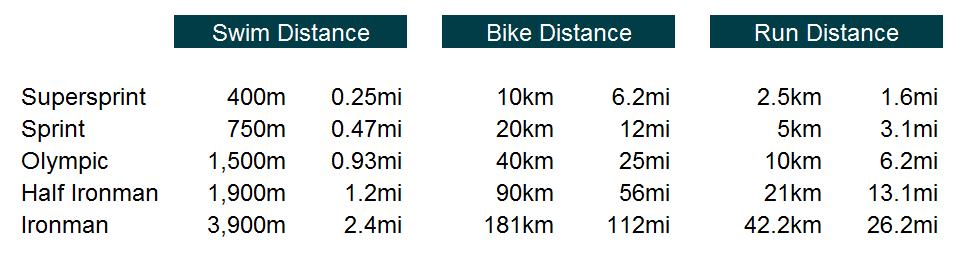
Shorter distance formats like the Sprint / Supersprint provide a great opportunity to try out the sport which is less daunting for first-timers. That is not to say that participation in these shorter formats is any less difficult or impressive. In the same way that an 18 minute 5K is as impressive as a sub-3 hour marathon, in the words of the famous cyclist Greg Lemond: “It never gets easier, you just go faster!” As the name suggests, the Olympic distance is the format utilized at the summer Olympics, having been introduced relatively recently at Sydney in 2000.
What is Ironman / Kona? A swimmer, cyclist, and runner walked into a bar…
While not the first format to be introduced, given its role in bringing the sport of triathlon into the mainstream, a strong argument can be made that the Ironman distance has the most heritage. The brainchild of John and Judy Collins, the first Ironman race was organized in 1978 in Oahu, Hawaii to settle a bar-room debate on which type of athlete: swimmer, cyclist, or runner, was the most fit. This new event combined the courses of three preexisting races: the Waikiki Roughwater Swim, the Around Oahu bike race, and the Honolulu Marathon, setting the precedent distances for subsequent Ironman races.

While the first race involved 15 athletes, participation exploded to such an extent that by 1980 the race was moved to its present (and more remote) location in Kona, Hawaii, and by 1983, a qualification system was introduced; turning the Kona Ironman into the Ironman World Championship. Today there are over 40 Ironman and 120 Half Ironman branded races held throughout the world each year.
As of 2019, out of the nearly 100,000 athletes that compete around the world each year, approximately 2,500 get the opportunity to race at Kona. Generally speaking, qualification for Kona can be achieved via the following methods:
- Standard qualification: Each of the ~40 full distance and a handful of half distance races around the world offer a number of Kona qualification slots, which are then divided up according to the size of each age group. Athletes then compete for these slots which are awarded based on placement within one’s age group. Ironman also allocates a number of slots for disabled athlete divisions.
- Lottery: Athletes that have completed a minimum of 12 full-distance Ironman races, have raced in the past year, and have never competed in Kona are entered into an annual lottery for a chance to participate.
- Donation: Through programs such as the Ironman Foundation or the Executive Program, folks that donate enough are granted entry. Opening bids typically start at $25k and are rumored to settle in the six figures.
Given the long history of the race and the extreme difficulty of securing a slot, Kona has established itself as the “holy grail” amongst triathletes and a bucket-list goal that some can spend decades pursuing. Prior to Ironman Wisconsin, many of you may have heard me joke of my “Kona by Age 50” initiative, the tongue-in-cheek rationale being that by age 50, one should have qualified because the competition has gotten slower, by sheer luck through the lottery, or have accumulated enough piggy bank money to buy in.
In my next post, I will provide an overview of my personal goals for the race as well as some inspiring stories over the years from the Ironman circuit.
#dacakeisalie
 KonaKorgi