
Through discipline comes freedom – Aristotle
The Benefits of a Training Plan
As crazy as the prospect of swimming 2.4 miles, cycling 112 miles, and running 26.2 miles sounds, like many other challenges, the Ironman is an undertaking which can be broken down into a series of more manageable tasks that can then be steadily ticked off on a daily basis. While there is an endless variety of recommendations on how to approach preparing for an Ironman (which we will explore in a subsequent post), the common thread amongst most coaches and physiologists is that ahead of any specific guidance on training intensity or volume, training consistency is perhaps the most important determinant of success. Having schlepped through three seasons and made a large number of newbie mistakes along the way, my limited n=1 experience in the sport to date would suggest that this is indeed the case.
In terms of establishing this consistency, many have asked me where one can find the daily motivation to tackle the training grind, to which my response has been that I have found motivation to be a very unreliable phenomenon that comes and goes on its own accord. I would be the first to admit that there have been many days when I wanted nothing more than to curl up under the duvet or to blow off an intimidating training set in favor of an evening of Netflix (I must give props to my swimmer friends as I am hard pressed to think of a less pleasant feeling than the initial plunge into a cold pool at 5am!). In place of motivation, I have found that a far more dependable path to cultivating training consistency is establishing a set of routines and habits. Although one of the more colorful characters in the endurance community, the Vegan Cyclist summarizes this far more humbly and eloquently than I can in the following video:
Given that no-one is born with habits and as someone who is as prone to laziness and inertia as everyone else, I have found that establishing a training plan beforehand, whether one works directly with a coach or uses a boilerplate regimen sourced online, is an effective way to establish a system of accountability. In addition to taking out the guesswork and potential friction of deciding what one needs to do on any given day, I have also found that following a training plan is an effective safeguard against burning oneself out through overtraining. When paired with the latest online applications such as TrainingPeaks or Strava, which allow athletes to track their gains in fitness, share with coaches and friends, and identify areas of strength and weakness, following a training plan in many ways allows one to “gameify” the training process, which in turn promotes greater compliance and thus more firmly establish consistency.
Kona Training Plan
With this context in place, my training plan for Kona is by and large the same as the regimen I had followed for IM Wisconsin last year. At a macro level, my season is structured into four-week mesocycles comprising of three weeks of the sessions outlined below, followed by 1 week of recovery (approximately a 50% reduction in volume). A typical training week consists of the following sessions:
- 4 bike rides:
- 1 long (easy effort) ride
- 1 continuous tempo (medium effort) brick session (bike followed by run)
- 1 sub-threshold (hard effort) interval ride
- 1 super-threshold (maximal effort) interval ride
- 3 swims:
- 1 technique-focused swim comprised mostly of drills
- 2 endurance-focused swims featuring longer intervals
- 4
runs:
- 1 long (easy effort) run
- 1 speed (hard-maximal effort) interval run
- 1 brick run (preceded by bike)
- 1 recovery (very easy effort) run
As a further illustration, the below screenshots from my TrainingPeaks account provide a good overview of what a typical early and late season training week look like.

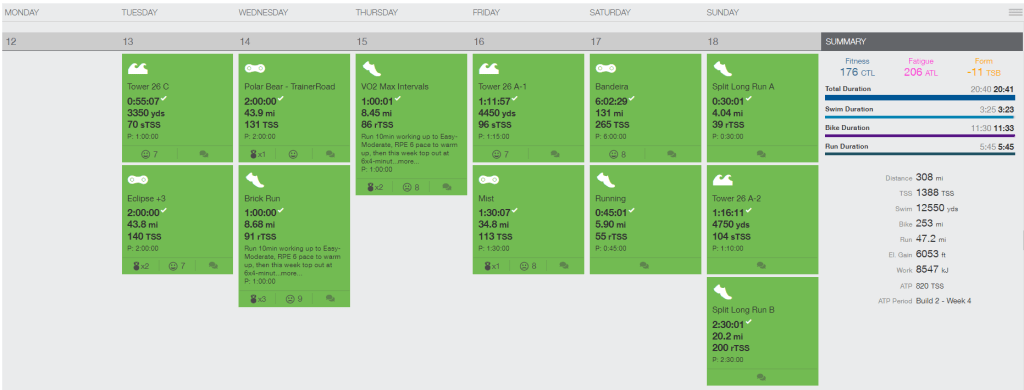
We will conduct a deeper dive into the exact makeup and progression of each of these sessions in a later post, but at a high level, this training season calls for a steady progression from approximately 11 hours of volume per week today (November 2019) to 20 hours per week three weeks prior to Kona (early September 2020). In those final three weeks, one generally executes what is known as a “taper” protocol by drastically reducing volume while maintaining intensity in order to shed residual fatigue and ensure fresh legs for race day.
Many who are interested into getting in the sport have often asked for my recommendation on what is the “best” or most effective training plan. Going back to the theme of cultivating consistency, my answer to this question has been whatever plan one believes he/she can follow with maximum compliance. It goes without saying that we are all subject to the inherent uncertainties of everyday life, including but not limited to career demands, family obligations, social calls, etc. Nevertheless, both the number of sessions and volume levels prescribed by the plan I’ve laid out for myself above have been carefully chosen to take these factors into account. For example, each week has inbuilt flexibility by including one day completely off and one day with only one shorter training session, both of which can be moved around to accommodate events such as travel, meetings, and social gatherings. In addition, this plan has been stress tested to a “surge capacity” scenario at work of 80 hours per week and a conservative minimum sleep requirement of 8 hours per day:

While everyone’s work demands and life situation can vary significantly (major respect to those of you who have kids!), the math I’ve laid out here hopefully shows the possibilities if one is judicious with one’s time. At a minimum, the math demonstrates that an unmarried, New York based, 29-year-old male with a relatively high-demand job should be able to maintain a Kona-qualifying training regimen. I should state however, that although triathlon is an individual sport, it should by no means be a lonely one. A major lesson that I’ve learned over the past few seasons has been the importance building a strong support team around oneself by cultivating buy-in and an understanding of one’s goals from friends, family and coworkers. This sense of community is extremely powerful, and was most certainly a contributing factor to my success in the sport thus far.
In my next post, I will conduct a deeper dive into the metrics and science behind endurance performance and how those inform the makeup of the individual training sessions outlined in this post. In the meantime, for those of you who would like to follow my training progress, most of my sets can be found on my Strava account at: https://www.strava.com/athletes/15134014.
#dacakeisalie
 KonaKorgi
5 thoughts on “Entry 3: Training Plan Part 1, Cultivating Consistency”