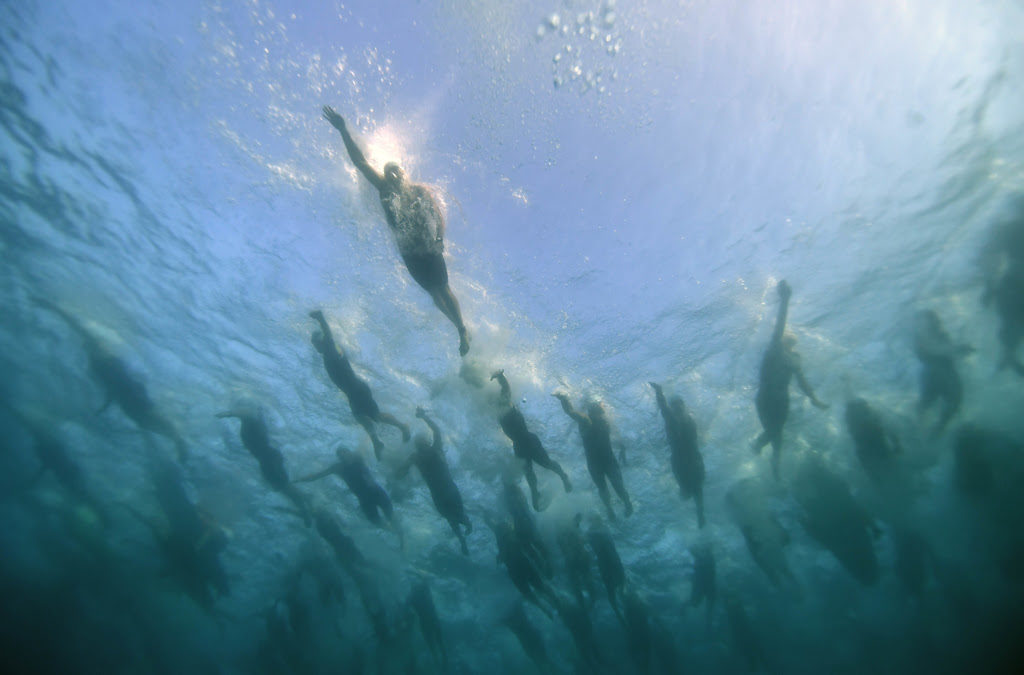
Like many other sports, triathlon has a vibrant community of athletes whose habits and mannerisms may at times seem odd or downright comical to outsiders. Having spent a great deal of time over the ten blog posts covering the technical details of my journey to Kona, it is about time that we explore some of the more lighthearted elements of the sport that I have encountered along the way. We will also explore the ways that such habits differ between triathletes and dedicated swimmers, cyclists, and runners.

Overview
Upon arriving at Lake Placid for my first Ironman back in 2018, a friend remarked: “my god, this is a festival for crazy people!” This statement is not without basis, as the sport does tend to attract folks who could be described as (i) type A (i.e. highly motivated but more accurately characterized as neurotic), (ii) attentive to detail and numbers-focused (anal), and (iii) gritty (masochistic). The following video is an old classic that does a wonderful job of portraying this personality.
Along the same vein, 220Triathlon circulated a fun list of 10 reasons why one should never date a triathlete. My friends and family can certainly attest to most if not all of these points. My personal favorite is #9: “There is literally nothing in the world more unpredictable and annoying than a tapering triathlete who will be variously moody, irrational, full of self-doubt, obsessed with the weather, germaphobic, restless, excited and anxious – otherwise known as a pain-in-the-ass.”
Spotting a triathlete in the wild is a relatively straightforward affair. Besides the dead give-away of the person in question wearing some form of race swag (definitely guilty of this myself; we triathletes are a narcissistic bunch), I have personally found that the most reliable identification method is the specific combination of (i) wearing a Garmin / similar fitness tracker and (ii) shaved legs, at least for male triathletes. The logic is as follows:

- Garmin: Runners use this to track their splits but swimmers and cyclists generally do not, instead utilizing pool-side clocks and bike-mounted computers respectively
- Shaved legs: Shaved legs provide a significant hydro/aerodynamic benefit for swimmers and cyclists but are far less important for runners
Wearing knee-high compression socks in public is also usually a pretty reliable giveaway. These methods are based upon my experience and I personally challenge my readers to inform me of other ways they have used to spot triathletes in the crowd.
Swimming:
When visiting the local lap pool, one would probably notice the exceptionally fast guy/gal in the middle lane whose stroke looks effortless and smooth. To be clear, that guy/gal is not a triathlete. The triathlete is more likely the person loudly thrashing around in lane 5.
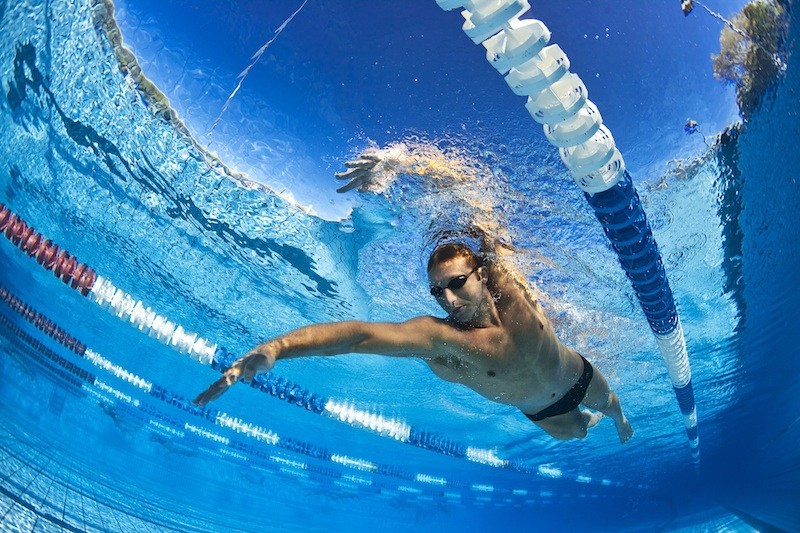

In all seriousness, unlike dedicated swimmers who have logged countless early mornings and tens of thousands of meters per week from an early age, the vast majority of age-group triathletes are adult-onset swimmers who have yet to achieve the same elasti-man levels of mobility and rhythm. This is compounded by the fact that triathletes also have to run, resulting in stiffer ankles and legs that tend to sink in the water.

Even at the pro-level, the fact that most triathlon races occur in open water which can be subject to windy and wavy conditions favors a choppier, windmill-like stroke style which looks very different from the classic, glidy-er style often seen with elite pool swimmers. Additional idiosyncrasies that differ between triathletes and swimmers include the following:
- Flip turns: The most efficient way to change direction once one hits the wall, the flip-turn is a major status symbol at any pool, separating the real swimmers from the mere mortals. Because of the lack of need to execute this in open-water races, many age group triathletes have yet to learn this dark and mysterious art.
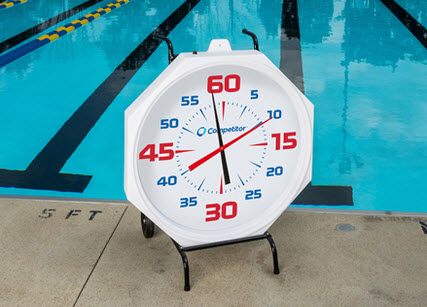
- Garmin: Given that triathletes are mentally challenged and overly reliant on fancy gadgets, they are forced to rely on these devices to measure out their splits, hitting the lap button after every rep to the frustration of lane-mates and swim coaches. By contrast, dedicated swimmers have had internal metronomes installed in their brains at birth and have mastered base-60 mathematics, allowing them to rely solely on the pool-side clock to measure out their splits.

Cycling:
For the uninitiated, the world cycling community is governed by an ironclad and sacred set of laws known as “The Rules” set by governing body of MAMILs (middle aged men in lycra) known as the Velominati. Below is a selection of highlights from this rulebook:
#9: If you are out riding in bad weather, it means you are a badass. Period. Fair-weather riding is a luxury reserved for Sunday afternoons and wide boulevards. Those who ride in foul weather – be it cold, wet, or inordinately hot – are members of a special club of riders who, on the morning of a big ride, pull back the curtain to check the weather and, upon seeing rain falling from the skies, allow a wry smile to spread across their face. This is a rider who loves the work.
#10: It never gets easier, you just go faster. As this famous quote by Greg LeMan tells us, training, climbing, and racing is hard. It stays hard. To put it another way, per Greg Henderson: “Training is like fighting with a gorilla. You don’t stop when you’re tired. You stop when the gorilla is tired.”
#12: The correct number of bikes to own is n+1. While the minimum number of bikes one should own is three, the correct number is n+1, where n is the number of bikes currently owned. This equation may also be re-written as s-1, where s is the number of bikes owned that would result in separation from your partner.
#25: The bikes on top of your car should be worth more than the car. Or at least be relatively more expensive. Basically, if you’re putting your Huffy on your Rolls, you’re in trouble, mister.
#7: Tan lines should be cultivated and kept razor sharp. Under no circumstances should one be rolling up their sleeves or shorts in an effort to somehow diminish one’s tan lines. Sleeveless jerseys are under no circumstances to be employed.
#20: There are only three remedies for pain. These are: (i) If your quads start to burn, shift forward to use your hamstrings and calves, or (ii) If your calves or hamstrings start to burn, shift back to use your quads, or (iii) if you feel wimpy and weak, meditate on Rule #5 and train more!
#5: Harden the f*ck up
Most pertinent to the discussion at hand:
#42: A bike race shall never be preceded with a swim and/or followed by a run. If it’s preceded with a swim and/or followed by a run, it is not called a bike race, it is called duathlon or a triathlon. Neither of which is a bike race. Also keep in mind that one should only swim in order to prevent drowning, and should only run if being chased. And even then, one should only run fast enough to prevent capture.
In addition to our violation of the above, we triathletes are oftentimes shunned by the cycling community for the following reasons:
- Socks: One’s sock game is a critical component of cycling culture, to the point that an entire section of the Velominati rulebook is dedicated to appropriate sock length and color combinations. In 2019, professional cycling’s governing body, the UCI, threw its weight into the ring by setting regulations on sock length. Due to our need to shave seconds off of the transition time between swimming and cycling, many triathletes choose to forgo wearing socks altogether, which is a major faux-pas in the eyes of the cycling community. This is in fact perhaps one of the most surefire ways to spot a triathlete amongst a group of cyclists.
- Handling skills: Unlike in cycling where the race dynamics are dominated by large packs of closely spaced riders seeking to draft off of each other, longer-format triathlon races often require athletes to maintain a certain minimum distance during the bike leg. As a result, triathletes will often spend a great deal of time training and racing alone, resulting in a not-unearned reputation of having subpar handling skills when riding in groups. On the flip side of the coin, because we forced to constantly break through the wind ourselves, my observation has been that triathletes tend to be much better at pacing longer steady-state efforts. As further consolation, a recent series of videos filmed by GCN indicates that a single rider on a triathlon bike can be faster than as many as 4 roadies working together in a paceline!
Running
Perhaps due in part to the lower barriers of entry equipment and facility-wise, the running community has cultivated a more open and inviting atmosphere for new athletes which has driven a massive increase in race participation over the past several decades but also leaves little for me to satirize vs. cycling (readers, please let me know if you have anything). Nevertheless, with the rise of social media, one phenomenon that I’ve found has affected both runners and triathletes in particular is the following existential question: “if you run a marathon, and there is no one there to Instagram it, did you really run a marathon?”. With the rise of Strava as the most common way to share one’s workouts with fellow athletes, the answer seems to be “if it is not recorded on Strava, it didn’t happen”.

In terms of differentiating triathletes from dedicated runners, I noted previously how triathletes oftentimes shave their legs to reduce drag on both the swim and bike. In addition, triathletes tend to carry more muscle mass in their upper bodies due to swimming which would only serve as deadweight for pure runners.
Racing
Given the distance involved, Ironman races are for the most part executed at an effort and pace that could be described as “conversational”. For this reason, I’ve found these events to be unique in that they enable a great deal of entertaining on-course banter and smack-talk. Some of my favorite personal anecdotes include:
- After a notorious downhill section of the Lake Placid bike course known as the “Keene Descent”, where athletes can expect to hit speeds of 50-60mph, an older gentleman quipped that he was pretty sure that he had sod himself.
- At an official electronic checkpoint on the furthest point of the Wisconsin bike course, a fellow athlete commented “yay, mommy knows I’m alive now!”
- On the Wisconsin run course, I encountered a group of athletes who were singing the Game of Thrones theme song to pass the time.
- On a particularly difficult climb on the Lake Placid bike course, an older lady verbally questioned my manhood as she passed me. Those of my male readers who are looking to do their first Ironman: avoid my mistake and follow the wise advice I received the day prior from the race director when faced with this situation – “let her go!”
Such hijinks occur even at the mecca of our sport. For example, Josh Amberger, a pro triathlete considered the best swimmer of the current generation, provided a colorful race report of his Kona experience:
While on the subject of racing, a question I am often asked is how athletes relieve themselves over the course of a race that can take the better part of a day. While porta-potties are spaced periodically throughout the bike and run courses, for pros and serious age-groupers whose margin of victory can sometimes be measured in seconds, the simple answer is that they often do the deed while riding and running. So the next time you are watching the live coverage of a race and see footage of someone generously pouring water on their lower body while riding / running, you now know exactly what is going on…
In my next post, we will explore the logistics of training during the winter. In the meantime, for those of you who would like to follow my training progress, most of my sets can be found on my Strava account at: https://www.strava.com/athletes/15134014.
#dacakeisalie
 KonaKorgi
One thought on “Entry 11: Triathlon Hijinks”